Learning to ask hard questions with humility
A reflection on a difficult passage about justice, a wise woman's quiet influence, and the continuing mission of the Lord's followers.
Reading · 2 Samuel 20–21 · Acts 1 · Psalm 121 · Proverbs 16
The theme
Today’s reading kept bringing me back to wisdom, justice, leadership, and faithfulness. A wise woman with no recorded office saved a city by speaking plainly to a commander. A king’s earlier wrongdoing cast a long shadow over the nation, and a difficult account of seven descendants being handed over for execution left me uneasy. In the New Testament reading, the Lord’s followers waited in prayer, replaced a betrayer among the twelve, and prepared to continue the mission they had been given. The Psalms reminded me that help comes from the Lord, who watches over His people, and Proverbs warned that pride comes before destruction. The main lesson for me was that human power and decisions need careful examination. God’s justice matters, but I should not assume that every decision recorded in Scripture was directly commanded by God.
What I sat with
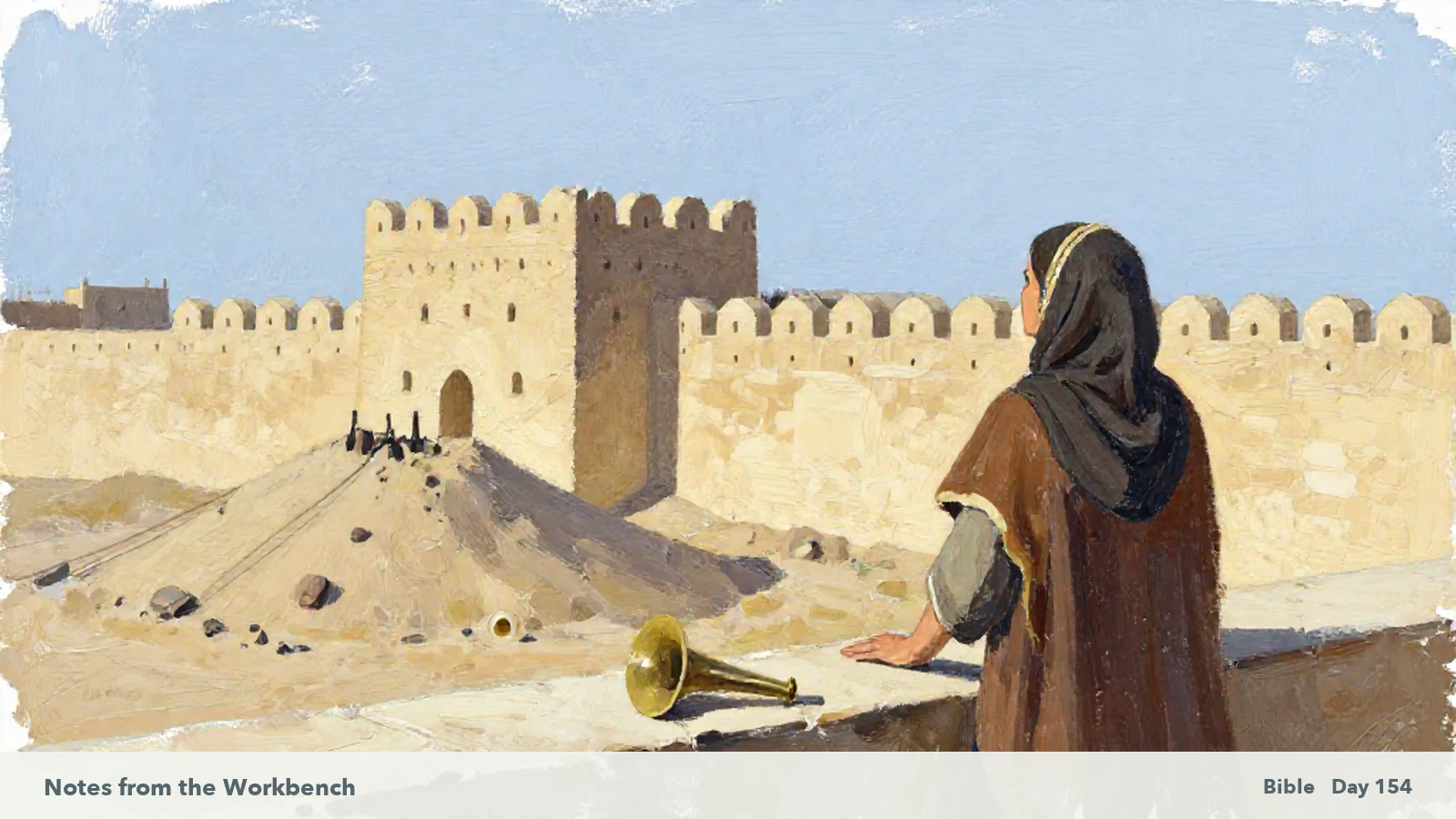
I spent the most time with the story of the wise woman. A rebel had fled into a city, an army surrounded it, and a commander was ready to break down its walls. The woman questioned why the city should be destroyed, learned what the commander wanted, and persuaded the people inside to hand over the rebel. The city was spared. I kept thinking about how leadership does not always require an official position. Wisdom, clear communication, and understanding a difficult situation can have real influence. At the same time, the way the rebel was killed still leaves moral questions.
I also sat with the famine and the executions. Scripture connects the famine to earlier bloodguilt, and the king asked how amends could be made. The request came from the wronged party, not directly from God, and seven descendants were killed. The passage does not record God commanding those executions. That distinction mattered to me, but it did not make the story easy. Other passages teach individual responsibility for sin, so I could not simply set the difficulty aside. I also noticed a mother who guarded the bodies of the dead, protecting their dignity in grief. Her vigil reminded me that political and religious decisions affect real families.
In the New Testament reading, I saw the Lord’s followers praying together and choosing another witness to take the place of the one who betrayed Him. They were preparing for a mission that would depend on the Holy Spirit. I learned that failure did not end the work, and that ordinary preparation mattered.
Questions I am still carrying
I am still carrying the question of how to deal with the consequences of past wrongdoing without punishing people who may be innocent. I wonder how to tell the difference between God’s explicit commands and human decisions that Scripture simply records. I also wonder what faithful amends looks like when a wrong is old and its effects are still being felt. And I keep thinking about the wise woman: how can I speak with wisdom in a difficult situation without pretending I have all the answers?
Prayer
Lord, some parts of Your Word are hard for me to understand, especially where suffering and injustice are involved. Please give me wisdom to understand Your truth and humility to admit when I do not know. Help me to care about people who are suffering and to be fair in my decisions. Thank You for showing me that You can use ordinary people to make a difference. Guide me by Your Spirit, and help me follow You faithfully. Amen.